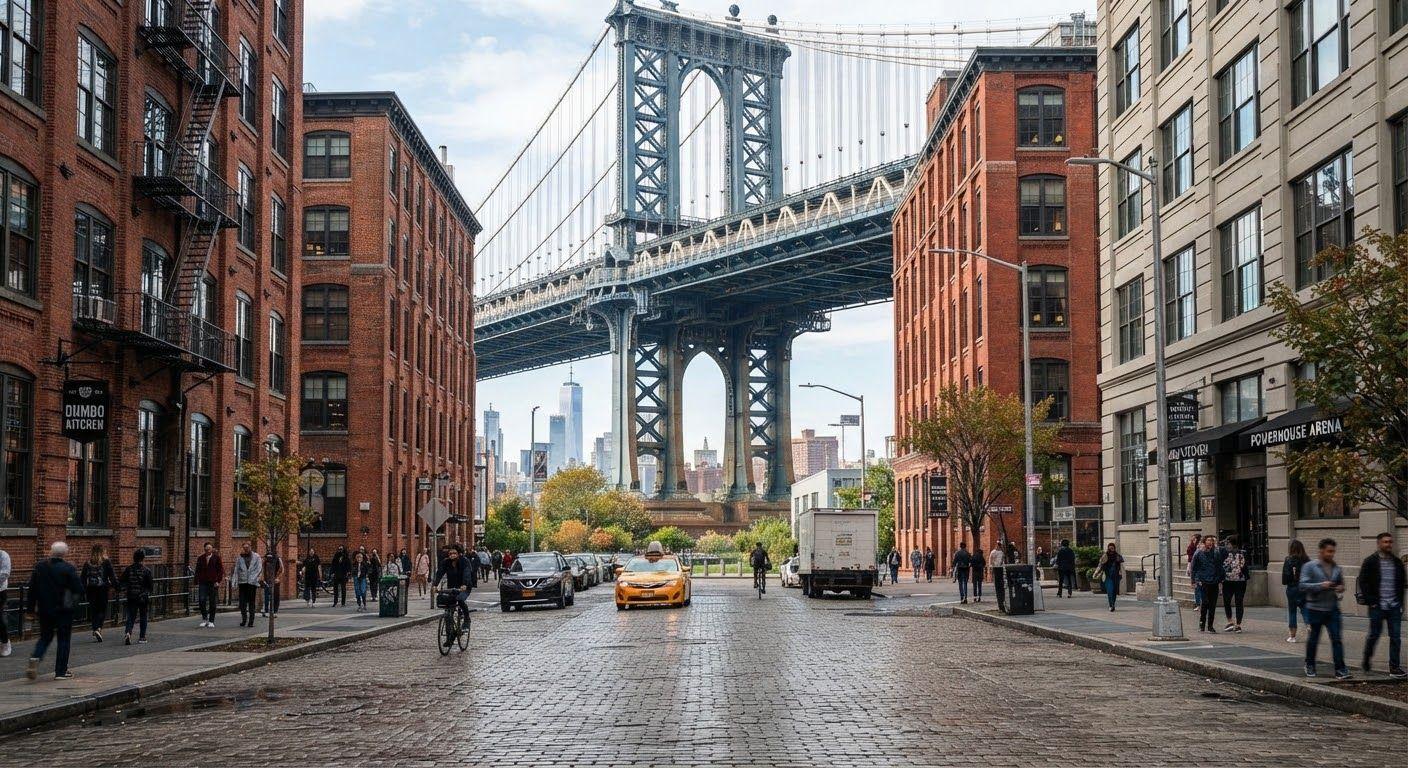
Stand at the intersection of Washington and Water Streets and look north: the rust-red brick canyons of nineteenth-century warehouses frame the blue steel anchorage of the Manhattan Bridge so symmetrically that the spire of the Empire State Building sits centered inside the bridge’s lower arch. It is one of the most iconic urban vistas on earth—and a testament to DUMBO’s industrial bones.
In the late 1800s, this stretch of the Brooklyn shoreline was known as Gairville, named after industrialist Robert Gair, who invented the pre-cut folding cardboard box right here on Washington Street and erected a fleet of monumental concrete-and-brick factories along the East River. Notice the original cast-iron railway tracks still embedded in the Belgian-block cobblestones, once used to haul paper and coffee sacks to the ferry slips.
When manufacturing moved out in the 1970s, pioneer artists moved into the cavernous, unheated lofts and coined the intentionally unglamorous acronym DUMBO—"Down Under the Manhattan Bridge Overpass"—hoping the clunky name would deter real estate developers from discovering their waterfront haven.
While the secret didn’t stay hidden forever, DUMBO’s adaptive reuse of its historic waterfront buildings is remarkable. Along the river, the 1860 Empire Stores coffee warehouse now offers a free public rooftop terrace overlooking both bridges, while next door, the roofless brick shell of an 1860 Civil War-era tobacco warehouse houses the acclaimed St. Ann’s Warehouse theater.
Step off the main tourist path onto Adams and Main Streets to browse The Powerhouse Arena (28 Adams St)—an independent art-book publisher and bookstore with soaring twenty-four-foot ceilings—and explore the photography galleries along Plymouth Street.
Before crossing back over the Brooklyn Bridge pedestrian walkway, grab an espresso at Butler on Water Street, watch the restored 1922 Jane’s Carousel spin inside its glass pavilion by architect Jean Nouvel, and sit on the smooth river stones of Pebble Beach as the East River ferries and tugboats churn past Lower Manhattan.