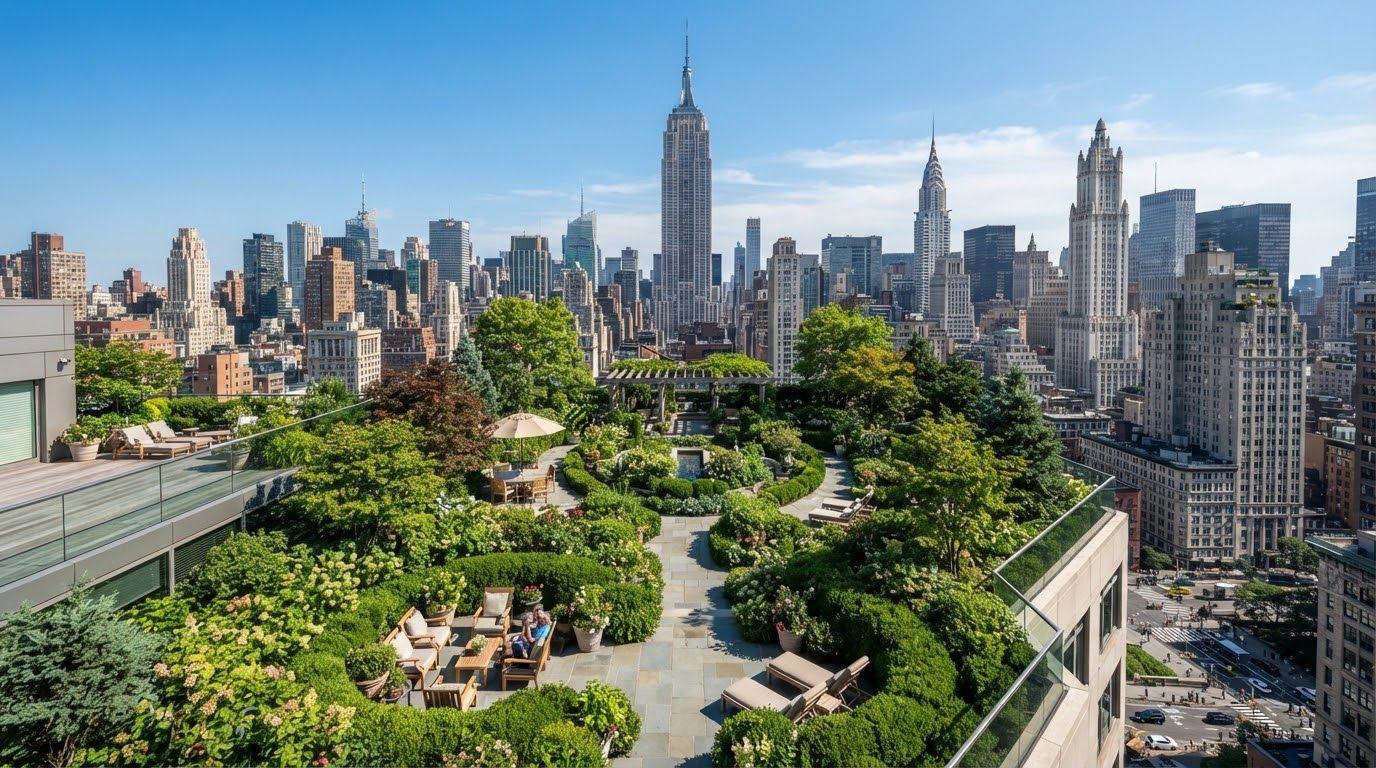
Few pedestrians gazing up at the Art Deco limestone grandeur of Rockefeller Center realize that directly above the Fifth Avenue storefronts sits a series of emerald rooftop gardens looking straight into the neo-Gothic spires of St. Patrick’s Cathedral.
Conceived in the 1930s by visionary developer Raymond Hood and designed by British landscape architect Ralph Hancock at the height of the Great Depression, the rooftop gardens of Rockefeller Center were originally envisioned as a "Hanging Gardens of Babylon" uniting the complex’s buildings with sky bridges. Four thousand tons of earth, three thousand bricks, and two thousand plants were hoisted seven stories above the street.
At 620 Loft & Garden (atop the British Empire Building at 620 Fifth Avenue), a manicured boxwood parterre and central reflecting pool mirror the stained-glass rose window of St. Patrick’s Cathedral just across the avenue. Even Higher up on the 11th floor of 30 Rockefeller Plaza, the larger Rooftop Park hides a rolling lawn, rock gardens, and resident beehives tended by the horticulture team.
Because 620 Loft & Garden operates primarily as a private venue, catching a glimpse requires booking one of Rockefeller Center’s seasonal architectural tours or attending a public cultural partnership event. Fortunately, New York’s zoning laws—specifically the city’s Privately Owned Public Space (POPS) program enacted in 1961—have created dozens of other elevated sanctuaries that are 100% free and open to the public every day.
Our favorite completely free sky park is The Elevated Acre at 55 Water Street in the Financial District. Accessed via an unassuming escalator tucked between two brick office towers, this one-acre meadow sits thirty feet above the FDR Drive, complete with a seven-tiered Brazilian hardwood amphitheater, wind-rustled dune grasses, and unobstructed views of the Brooklyn Bridge and East River ferries.
Back in Midtown East, duck inside the Ford Foundation Center for Social Justice at 320 East 43rd Street. Designed by Kevin Roche and Dan Kiley in 1967, its soaring twelve-story glass atrium encloses a lush, climate-controlled subtropical woodland garden with thirty-nine species of trees, brick footpaths, and a tranquil sensory pool—completely free to walk through on weekdays.